
Jacking Instructions
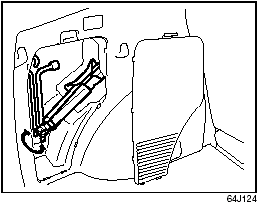
Jacking Instructions
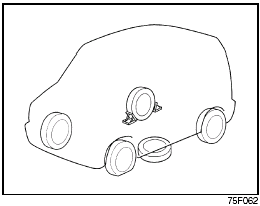
1) Place the vehicle on level, hard ground.
2) Set the parking brake firmly and shift into “P” (Park) if your vehicle has an automatic transmission, or shift into “R” (Reverse) if your vehicle has a manual transmission.
3) Turn on the hazard warning flasher if your vehicle is near traffic.
4) Block the front and rear of the wheel diagonally opposite of the wheel being lifted.
5) Place the spare wheel near the wheel being lifted as shown in the illustration in case that the jack slips.
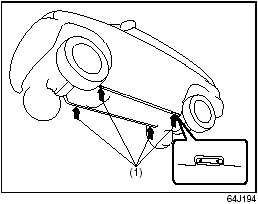
(1) Jacking point
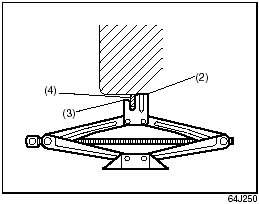
(2) Upper flat surface
(3) Lower flat surface
(4) flange of the body
6) Position the upper flat surface (2) of the jack at the inside of the underbody flange as shown in the illustration.
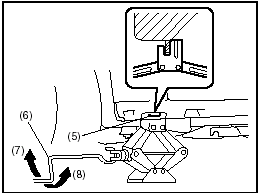
Front
(5) Designated jacking point
(6) Jack handle
(7) Raise
(8) Lower
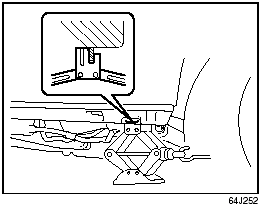
Rear
7) Position the jack vertically and raise the jack by turning the jack handle clockwise until the jack head recess fits around the flange at the designated jacking point as shown in the illustration.
8) Continue to raise the jack slowly and smoothly until the tire clears the ground. Do not raise the vehicle more than necessary.
 WARNING:
• Use the jack only to change wheels
on level, hard ground.
• Never jack up the vehicle on an inclined surface.
• Never raise the vehicle with the jack in a location other than the designated jacking point near the wheel to be changed.
• Make sure that the jack is raised at least 51 mm (2 inches) before it contacts the flange. Use of the jack when it is within 51 mm (2 inches) of being fully collapsed may result in failure of the jack.
• Never get under the vehicle when it is supported by the jack.
• Never run the engine when the vehicle is supported by the jack and never allow passengers to remain in the vehicle.
See also:
Improving Fuel Economy
The following instructions will help you
improve fuel economy.
Avoid excessive idling
If you are to wait for more than a minute
while you are parked, stop the engine and
start it again later. Whe ...
Front Seat Heater (if equipped)
Front Seat Heater (if equipped)
With the ignition switch in the “ON” position,
push in one or both of the seat heater
switches to warm the corresponding
seat(s). The indicator light below th ...
Overview
Suzuki SX4 is a distinctive five-door hatchback that blends the
characteristics of sporty compacts exemplified by the Swift, with those of
lightweight SUVs such as the Grand Vitara, to create an e ...