
Exhaust Gas Warning
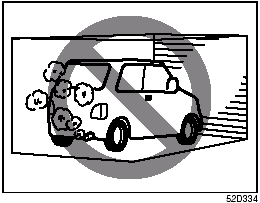

WARNING:
Avoid breathing exhaust gases.
Exhaust gases contain carbon monoxide, a potentially lethal gas that is colorless and odorless. Since carbon monoxide is difficult to detect by itself, be sure to take the following precautions to help prevent carbon monoxide from entering your vehicle.
• Do not leave the engine running in garages or other confined areas.
• Do not park with the engine running for a long period of time, even in an open area. If it is necessary to sit for a short time in a parked vehicle with the engine running, make sure the air intake selector is set to “FRESH AIR” and the blower is at high speed.
• Avoid operating the vehicle with the tail gate or trunk open. If it is necessary to operate the vehicle with the tail gate or trunk open, make sure the sunroof (if equipped) and all windows are closed, and the blower is at high speed with the air intake selector set to “FRESH AIR”.
• To allow proper operation of your vehicle’s ventilation system, keep the air inlet grille in front of the windshield clear of snow, leaves or other obstructions at all times.
• Keep the exhaust tailpipe area clear of snow and other material to help reduce the buildup of exhaust gases under the vehicle. This is particularly important when parked in blizzard conditions.
• Have the exhaust system inspected periodically for damage and leaks.
Any damage or leaks should be repaired immediately.
See also:
Basic Power
This year's four-cylinder engine gains some guts — it makes 150 horsepower,
up from last year's 143 — and it works through either a stick shift or a new
continuously variable automatic transmi ...
Corrosion Prevention
It is important to take good care of your
vehicle to protect it from corrosion.
Listed below are instructions for how to
maintain your vehicle to prevent corrosion.
Please read and follow these in ...
Fuel Gauge
Fuel Gauge
This gauge gives an approximate indication
of the amount of fuel in the fuel tank.
“F” stands for full and “E” stands for empty.
If the indicator gets off the graduation of
â ...