
Exhaust Gas Warning
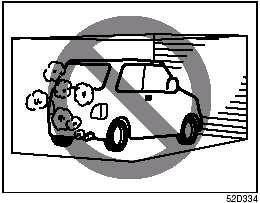

WARNING:
Avoid breathing exhaust gases.
Exhaust gases contain carbon monoxide, a potentially lethal gas that is colorless and odorless. Since carbon monoxide is difficult to detect by itself, be sure to take the following precautions to help prevent carbon monoxide from entering your vehicle.
• Do not leave the engine running in garages or other confined areas.
• Do not park with the engine running for a long period of time, even in an open area. If it is necessary to sit for a short time in a parked vehicle with the engine running, make sure the air intake selector is set to “FRESH AIR” and the blower is at high speed.
• Avoid operating the vehicle with the tail gate or trunk open. If it is necessary to operate the vehicle with the tail gate or trunk open, make sure the sunroof (if equipped) and all windows are closed, and the blower is at high speed with the air intake selector set to “FRESH AIR”.
• To allow proper operation of your vehicle’s ventilation system, keep the air inlet grille in front of the windshield clear of snow, leaves or other obstructions at all times.
• Keep the exhaust tailpipe area clear of snow and other material to help reduce the buildup of exhaust gases under the vehicle. This is particularly important when parked in blizzard conditions.
• Have the exhaust system inspected periodically for damage and leaks.
Any damage or leaks should be repaired immediately.
See also:
Tilt Steering Lock Lever (if equipped)
The lock lever is located under the steering
column. To adjust the steering wheel
height:
1) Pull up the lock lever to unlock the
steering column.
2) Adjust the steering wheel to the desired
h ...
Shortcomings
The Kizashi does have its shortcomings, one of which is backseat roominess:
As mentioned in the 2010 review, legroom in particular is a couple of inches
below the norm. It also has a couple of qui ...
Under the hood
Engine and transmission configurations include:
152-horsepower, 2.5-liter inline-four-cylinder, aluminum block/cylinder head,
DOHC, four valves per cylinder with 171 pounds-feet of peak torque 261 ...